

RESOURCES
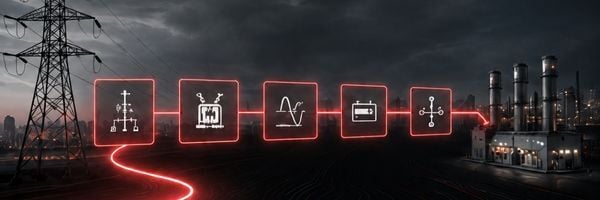
Modern power systems rely on more than one component. From the incoming utility connection to the equipment using the power, every stage must work together to deliver reliable, efficient, and controlled performance.
A grid-to-load power architecture brings power control, transformation, conversion, filtering, sensing, storage, and distribution into one coordinated system. By considering the complete power path early in the design process, OEMs and system integrators can simplify integration, reduce compliance risks, and build a solution around the application’s specific requirements.
Start with a Stable Power Input
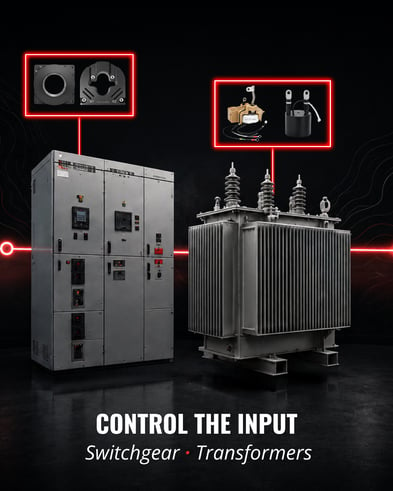
The power path begins at the facility or system input. Switchgear protects and controls the incoming electrical connection, while transformers adjust voltage levels and provide isolation for downstream equipment.
Current transformers add accurate sensing for system monitoring, metering, control, and protection. Together, these components establish a stable electrical foundation before power reaches the conversion stage.
Key input-stage requirements include:
- Input voltage, current, frequency, and phase
- Voltage transformation and electrical isolation
- Current sensing and system monitoring
- Inrush current and fault protection
- Switching and control requirements
- Space, cooling, and environmental conditions
Convert Power with Confidence
Once the input is controlled, it must be converted into the voltage and current required by the load. High-power AC/DC and programmable power supplies provide the precise and efficient conversion needed in demanding industrial and technology applications.
The conversion stage must also account for electromagnetic interference. High-current and high-voltage EMI/EMC filters help reduce conducted noise traveling between the grid, power converter, and connected equipment.
Selecting the appropriate filter architecture early in the design process can lower compliance risks, improve system performance, and help prevent costly redesigns.
Important conversion requirements include:
- Output voltage, current, and total power
- Constant-voltage or constant-current operation
- Dynamic and pulsed-load behavior
- Efficiency and thermal management
- Conducted emissions and immunity requirements
- Single-phase or three-phase input
- Communications and control interfaces
Store and Distribute Energy
After conversion, power may need to be stored, protected, monitored, and distributed across several connected loads. Energy storage can provide backup power, load balancing, and system continuity, while power distribution units organize and control delivery to downstream equipment.
.png?width=338&height=423&name=Control%20the%20Input%20Switch%20Gear%20Transformers%20(1).png)
Additional EMI filtering or current sensing may also be required at the distribution or load level. Positioning filters and sensors close to sensitive equipment can help control localized noise, improve system visibility, and protect performance throughout the power path.
Distribution-stage considerations include:
- Number and type of connected loads
- Branch-circuit protection
- Current and voltage monitoring
- Power density and enclosure space
- Backup-power requirements
- Load-level EMI filtering
- Communications and remote control
Why a Complete-System Approach Matters
The most effective power architectures are designed as coordinated systems, not assembled as isolated components. Transformers, current sensing, power conversion, EMI/EMC filtering, energy storage, and power distribution must perform together under real operating conditions.
This complete-system approach is especially important in demanding applications such as:
- Semiconductor manufacturing
- Industrial automation
- Data centers
- Energy storage systems
- Hydrogen generation
- Medical equipment
- Military and aerospace systems
In these environments, uptime, efficiency, compliance, power density, and scalability are critical to overall system performance.
The Astrodyne TDI Advantage: One Partner at Every Stage
Astrodyne TDI supports the power path from grid to load with power transformers, current transformers, high-power and programmable power supplies, EMI/EMC filters, power distribution units, and custom-engineered integration.
Bringing these capabilities together helps customers reduce interface challenges, simplify sourcing, accelerate development, and create reliable power architectures tailored to their applications.
From the first connection to the final load, Astrodyne TDI helps make every stage of power work together.
Now you have power.
Ready to Build Your Complete Power Architecture?
Whether you are developing a new power system or upgrading an existing design, Astrodyne TDI can help evaluate your power conversion, transformation, filtering, sensing, storage integration, and distribution requirements.
Talk to our engineering team about your grid-to-load power architecture.