

RESOURCES
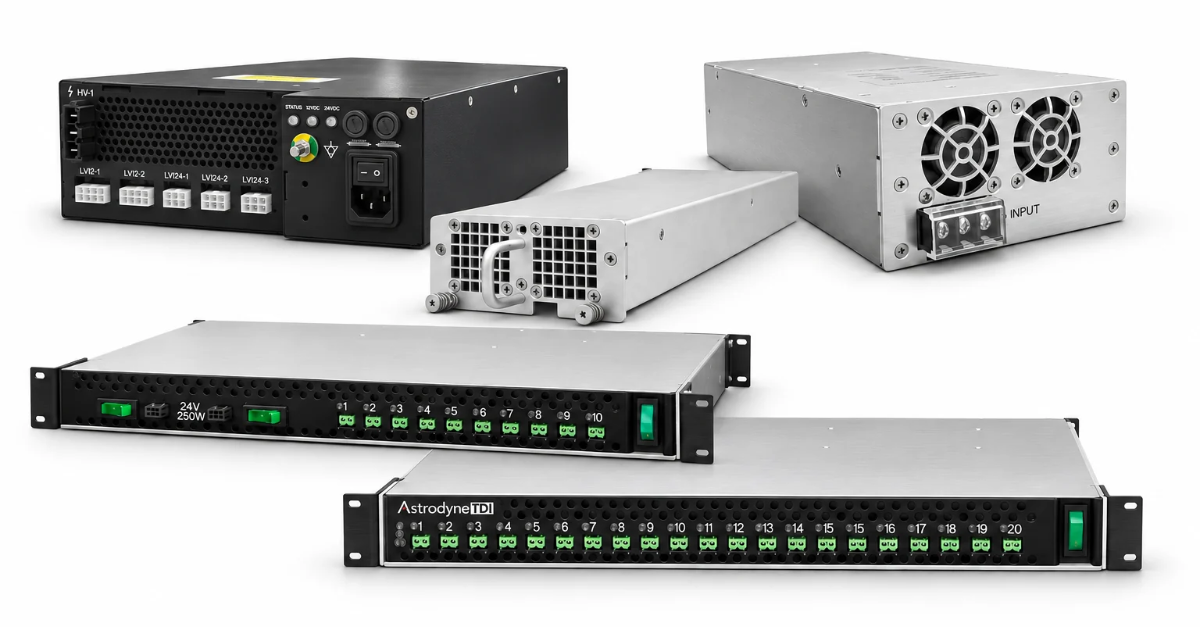 Small Power Supplies. Big Impact on Tool Uptime.
The power supplies running a tool’s controls may be small, but their impact on productivity is not. A brief interruption to a sensor, interlock, or controller can stop an otherwise healthy system—and leave expensive equipment idle.
Multi-output housekeeping power supplies bring these auxiliary power needs into one engineered assembly. For complex tools, that can mean simpler wiring, easier troubleshooting, and more predictable performance.
What is housekeeping power?
Behind a tool’s main power system is a network of lower-power outputs, often called rails, that support essential functions:
- Motion controllers and communications
- Sensors and monitoring equipment
- Interlocks and safety circuits
- Other internal controls
These outputs commonly range from 5 V to 60 V. They may receive less attention than the tool’s main power stage, but they help determine whether the equipment starts correctly, stays running, and recovers from a power disturbance.
If one critical control supply drops out during a voltage sag, the entire tool may stop. In semiconductor manufacturing, that interruption can put work in progress at risk and reduce productive operating time.
The hidden cost of separate supplies
Using individual power supplies for each function can look economical on a bill of materials. As the tool becomes more complex, however, that approach can create additional work throughout its life.
Each supply brings its own wiring, mounting requirements, start-up behavior, and fault response. Bringing them together does not automatically make them behave as a coordinated system.
The resulting challenges often include:
- More integration work: Additional cables, connectors, mounting points, and parts to manage.
- Uneven response to disturbances: Some outputs may remain active during a voltage sag while others shut down.
- Longer troubleshooting: A power issue may first appear as a communication error, sensor fault, or unexpected reset.
- More service complexity: Different tool configurations may require different replacement parts and repair procedures.
The cost extends beyond the supplies themselves. Engineering time, qualification effort, and downtime all affect the value the tool delivers.
A more coordinated approach to auxiliary power
A multi-output housekeeping assembly treats power as one defined subsystem.
Instead of placing separate converters throughout the tool, the design brings the required outputs into a common assembly built around the application’s voltage, current, isolation, and packaging needs.
For example, a rack-mounted assembly can house multiple AC-DC modules to support control voltages such as ±15 V and 24 V. Outputs can remain electrically isolated where required, while sharing mechanical packaging and system connections.
This approach can make the tool easier to build and support:
Simpler wiring and layout. Defined connection points help reduce scattered power components and make harness routing more consistent.
More predictable operation. Engineers can evaluate start-up, shutdown, protection, and thermal behavior as part of a complete subsystem.
Easier troubleshooting. A central power assembly gives service teams a clear place to begin investigating power-related faults.
More consistent platform designs. A common architecture can support multiple tool configurations, reducing the number of unique assemblies to qualify and maintain.
These benefits depend on the design. Consolidation alone does not guarantee coordinated outputs, better emissions performance, or improved reliability.
Design for voltage sags—and recovery
Keeping a tool running through a brief voltage sag requires attention to its auxiliary supplies as well as its main power stage.
For semiconductor equipment with SEMI F47 requirements, the housekeeping subsystem must support the tool’s required sag response. A critical controller dropping out can interrupt operation even when the main power system remains available.
An engineered assembly allows designers to consider the required energy storage, output hold-up time, and recovery sequence together. The goal is to keep essential controls powered for the required duration and ensure predictable behavior when normal input power returns.
Ride-through performance must be verified under the intended operating conditions. A wide input range or power factor correction alone does not establish compliance.
Make power performance easier to see
Monitoring can also make auxiliary power easier to manage.
Depending on the design, a digital interface such as CAN bus can provide output voltage, current, and status information to the tool controller. Remote on/off control may also be available.
That visibility can help teams identify an overloaded output, investigate intermittent faults, or spot changes in power demand over time. Combined with appropriate thresholds and operating history, it can support maintenance planning.
Serviceability should be designed in as well. Accessible connectors and replaceable modules can simplify repairs. Hot-swap capability, where required, must be specifically supported by the assembly and the tool.
Example: one architecture for multiple tool configurations
Consider a tool platform that needs independent ±15 V and 24 V control outputs, with two configurations requiring approximately 550 W and 1,000 W.
Building each version from separate supplies can lead to different part numbers, mounting arrangements, and wiring layouts. Over time, those differences add to purchasing, documentation, and service requirements.
A common multi-output assembly provides a more consistent foundation. The module configuration can be tailored to each power level while maintaining a similar mechanical format and connection strategy.
For this type of application, established converter modules can provide the starting point, with customization focused on:
- Output voltages, currents, and isolation
- Packaging and cooling
- Connectors and harness interfaces
- Control and monitoring requirements
Standardizing the architecture can simplify qualification, spare-parts planning, and technician training across the platform.
When does a custom assembly make sense?
A custom or semi-custom solution becomes worth considering when separate catalog supplies make the overall system harder to integrate, qualify, or maintain.
Start with a few practical questions:
- How many outputs are required, and which need electrical isolation?
- How must each output respond to changing loads or input disturbances?
- What start-up and shutdown sequences does the tool require?
- Which safety, EMC, and ride-through requirements apply?
- Would remote monitoring or control improve troubleshooting?
- Can the solution fit the available space and cooling conditions?
- How will replacement parts and configuration changes be managed over the tool’s life?
A simple system may be well served by individual supplies. As requirements grow, a coordinated assembly can reduce the work needed to keep those supplies operating together.
Protect uptime from the controls up
Housekeeping power supports the functions that keep a complex tool productive. Its design deserves the same system-level attention as the main power stage.
A well-engineered multi-output assembly can simplify integration, improve visibility, and support predictable operation through disturbances. For equipment manufacturers and operators, that means fewer power-related interruptions and more time in production.