

RESOURCES

What the Semiconductor Manufacturing Boom Means for Power Electronics Suppliers
Global semiconductor fab construction has reached a historic scale. Dozens of new fabrication facilities are under construction or have been newly announced across the United States and Asia, each racing to come online as quickly as possible.
For instance, Micron is building a $24 billion facility in Singapore, which could require as many as 500 power transformers, more than double the annual output of any single Taiwanese manufacturer. That single project shows how much capacity a modern fab pulls from an already tight supply chain. The company is also planning to build plants in Idaho, New York and Hiroshima.
In the United States, the CHIPS Act has catalyzed nearly $450 billion in planned investment, funding 17 new fabrication facilities across the nation. Each facility draws on transformers, power supplies and electromagnetic interference (EMI) filters serving industrial, medical and defense original equipment manufacturers (OEMs). For power electronics suppliers, demand now spans dozens of builds competing for the same limited pool of components.
The Fab Buildout: Scale and Speed
Fab construction in the U.S. has accelerated due to a combination of CHIPS Act incentives, surging demand for AI chips and a broader push to reshore manufacturing. Three of the industry's largest commitments demonstrate the scale of this growth. For starters, Intel has pledged nearly $90 billion to expand production across four U.S. states. TSMC's $65 billion investment in three new Arizona fabs stands as the largest foreign direct investment in a greenfield project in U.S. history. Samsung has also committed more than $37 billion to expand its Texas operations.
Together with other planned projects, these investments are expected to bring eight new leading-edge logic fabs online by 2030, increasing U.S. production of the world's leading-edge logic chips from 0% in 2022 to 20% by the end of the decade.
Collectively, these fabs are adding 6.8 million square feet of new clean room space, an area equivalent to about 119 football fields. That scale of construction extends well beyond clean rooms and process tools alone. Each facility is also a massive power infrastructure project in its own right, requiring transformers, switchgear, uninterruptible power supplies, power distribution units and EMI-filtered power circuits throughout every production area.
A single project can consume more power infrastructure than most industrial facilities need in years, and dozens of such projects are underway worldwide. Every one of those projects draws from the same limited pool of semiconductor fab equipment and power components, which is why the infrastructure crunch is becoming so difficult to navigate.
The Infrastructure Crunch: Large Power Transformers and Switchgear
The large power transformer shortage predates the current wave of fab construction. Data center buildout and grid modernization projects had already pushed lead times to historic highs, and fab construction now adds a third major source of demand competing for the same limited supply of heavy electrical equipment.
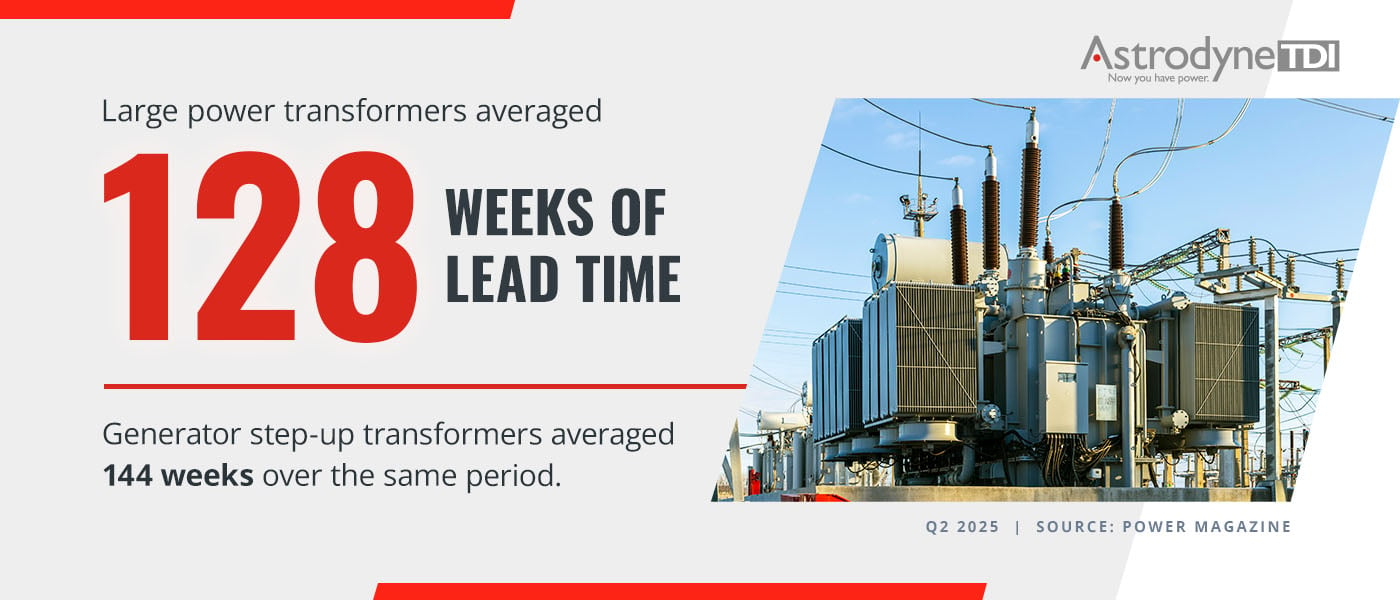
Large power transformers (LPTs), the heavy-duty units that step voltage up or down at substations and major industrial sites, averaged 128 weeks of lead time in the second quarter of 2025. Generator step-up transformers, used to connect generation sources to the grid, averaged 144 weeks over the same period.
Switchgear and medium-voltage distribution equipment also face constraints, with lead times averaging 44 weeks. Prices have climbed alongside the delays, with power transformer prices up 77% since 2019. Medium-voltage switchgear prices have also risen 50% since 2021, squeezing project budgets and stretching project schedules.
The bottleneck traces back to raw materials, specifically grain-oriented electrical steel (GOES), the specialized steel used to build transformer cores. According to the U.S. Department of Energy's 2022 review, only one company manufactures GOES in the U.S., a scarcity that helps explain why 82% of large power transformers consumed in the country were imported as of 2019. The heavy reliance on imports leaves the supply chain exposed to shipping delays, tariffs and overseas production schedules that U.S. buyers cannot control.
For buyers planning fab projects now, transformers and switchgear ordered today may not arrive until much later in the project timeline. As a result, experience managing long lead times is becoming a baseline requirement for every supplier seeking to avoid transformer shortages, which impact semiconductor production.
The Component Crunch: PMICs, VRMs and SiC Modules
Beyond the infrastructure-level shortage, a second bottleneck is building at the component level, worsening lead times for power components used in semiconductor fabrication.
Power management integrated circuits (PMICs), the chips that regulate voltage and current across circuit boards, and voltage regulator modules (VRMs), which step down voltage locally to processor and memory circuits, are both seeing lead times extend well beyond historical norms. According to some industry reports, PMIC lead times now run 35 to 40 weeks, as AI server demand pulls supply away from general-purpose server production.
Silicon carbide (SiC), a wide-bandgap semiconductor material used in high-efficiency power conversion, adds another layer of pressure. This component is essential in making industrial motor drives, data center power stages and fab power conditioning equipment. The U.S. Department of Energy has identified domestic SiC packaging capacity as a documented vulnerability in the broader power semiconductor supply chain, meaning that even buyers who secure wafer supply may still face downstream delays in packaging and assembly.
In short, fab construction teams and tool manufacturers are now drawing from the same limited pool of power components that OEMs rely on for their own product lines, intensifying competition across the entire buyer base.
What the Power Component Shortage Means for Suppliers and Buyers
Infrastructure and component shortages are reshaping how OEMs and contract manufacturers need to approach the power electronics supply chain. Here are some proactive steps engineers and procurement professionals can take to mitigate these issues:
- Secure capacity early: Buyers who wait until a project is confirmed before sourcing transformers, switchgear or power components will find that lead times push delivery past critical construction milestones. Capacity reserved during the planning phase, before specifications are finalized, often beats capacity sought after a project is already underway, when factory slots may no longer be available.
- Prioritize domestic sourcing: U.S.-based manufacturers offer shorter supply chains and are better positioned to meet CHIPS Act domestic content preferences.
- Lock in long-term supply agreements: Spot purchasing in a constrained market carries premium pricing and quality risk, since suppliers under pressure prioritize their most committed customers. A long-term agreement gives both the buyer and the manufacturer the planning visibility needed to protect delivery schedules on both sides.
- Qualify multiple suppliers: Sole-sourcing any critical power component, including PMICs, SiC modules or large transformers, creates a single point of failure in a project plan. Consider a broader supplier base to strengthen your plan.
Create a Resilient Plan With Astrodyne TDI
The semiconductor fab boom shows no signs of slowing, and the strain it places on transformers, switchgear, and power components is structural rather than temporary. Buyers who secure capacity and lock in supply relationships now will be better positioned than those who treat sourcing as an afterthought.
Astrodyne TDI brings more than 60 years of experience designing power components for semiconductor manufacturing and fab construction, including AC/DC power supplies, EMI filters, and custom solutions for industrial, medical, aerospace and military applications. With engineering and manufacturing based in the United States, we work alongside procurement and design teams to plan purchases and avoid the last-minute scramble. Contact our team to discuss supply chain planning or request a quote for your next project.