RESOURCES
Why Use a UPS System in Your Semiconductor Applications
Semiconductors support technologies across artificial intelligence, industrial automation, medical facilities, energy systems and beyond. To meet global demand, semiconductor manufacturing environments operate at high levels of precision.
In modern fabrication facilities, tools execute synchronized steps at nanometer scales, making them sensitive to even brief disturbances on the utility line. Having consistent, stable electricity influences yield, equipment health and process repeatability.
An uninterruptible power supply (UPS) responds without delay. Equipment continues operating or transitions through controlled shutdown sequences without losing data integrity. This article explains how UPS systems support uptime, protect yield and reduce operational risk.
Understanding Semiconductor Manufacturing
Semiconductor manufacturing converts raw wafers into functional devices through a controlled sequence of steps. These wafers are most often made of silicon, but some applications use gallium arsenide, gallium nitride, silicon carbide or indium phosphide.
The process includes deposition, photolithography, etching, ion implantation, oxidation, and other thermal processing steps, with inspection and metrology performed throughout to ensure process flow. As chip feature sizes become smaller, the margin for error decreases, making each production stage more vulnerable to minor variations.
Precision and Process Sensitivity
Fabrication tools rely on exact electrical behavior to control plasma characteristics, temperature uniformity, motion accuracy and timing coordination. Even small deviations in electricity can alter the process conditions to introduce defects that may only become apparent later in the process.
Process effects include:
- Unstable plasma during etching or deposition processes
- Pattern or exposure errors occur when lithography systems lose timing or motion precision
- Temperature fluctuations degrade material properties and chip performance
Clean Room Stability and Interdependence
Clean room stability involves more than just controlling particles. Consistent electricity drives manufacturing systems, including airflow control, temperature management, monitoring equipment and process control networks.
Since fabrication works in coordinated sequences, a disruption in one area can quickly spread to others. Stable powers keep these interdependent systems synchronized, maintaining consistent process control and repeatability throughout the entire manufacturing workflow.
How Can Power Issues Impact Semiconductor Manufacturing?
Power interruptions can incur higher costs in semiconductor fabrication. In-process wafers, tightly sequenced tools and continuous production flows can't tolerate disruptions. This shows how power issues impact semiconductor manufacturing by turning seconds of instability into scrapped wafers, lost capacity and expensive recovery cycles.
Electrical interruptions affect manufacturing in the following ways:
- Wafer loss: Wafers already in process may be scrapped if power is lost, as many fabrication steps can't resume in the same physical or chemical state.
- Tool unavailability: Power interruptions force tools offline for inspection, recalibration and process stabilization. This reduces usable production capacity.
- Facility and water damage: Loss of electricity can disrupt pumps, valves and temperature control systems, leading to leaks or condensation that can damage tools, clean room infrastructure and in-process wafers.
- Recovery overhead: Engineering and operation teams must validate equipment condition, contamination levels and process readiness before fabrication can resume.
- Supply chain disruption: Lost output at a single fabrication facility can reduce available chip supply and have a ripple effect on downstream manufacturing schedules.
- Direct financial loss: Scrapped wafers, damaged equipment, lost capacity and extended recovery efforts can result in high costs for a single outage.
Key UPS Features for Semiconductor Applications
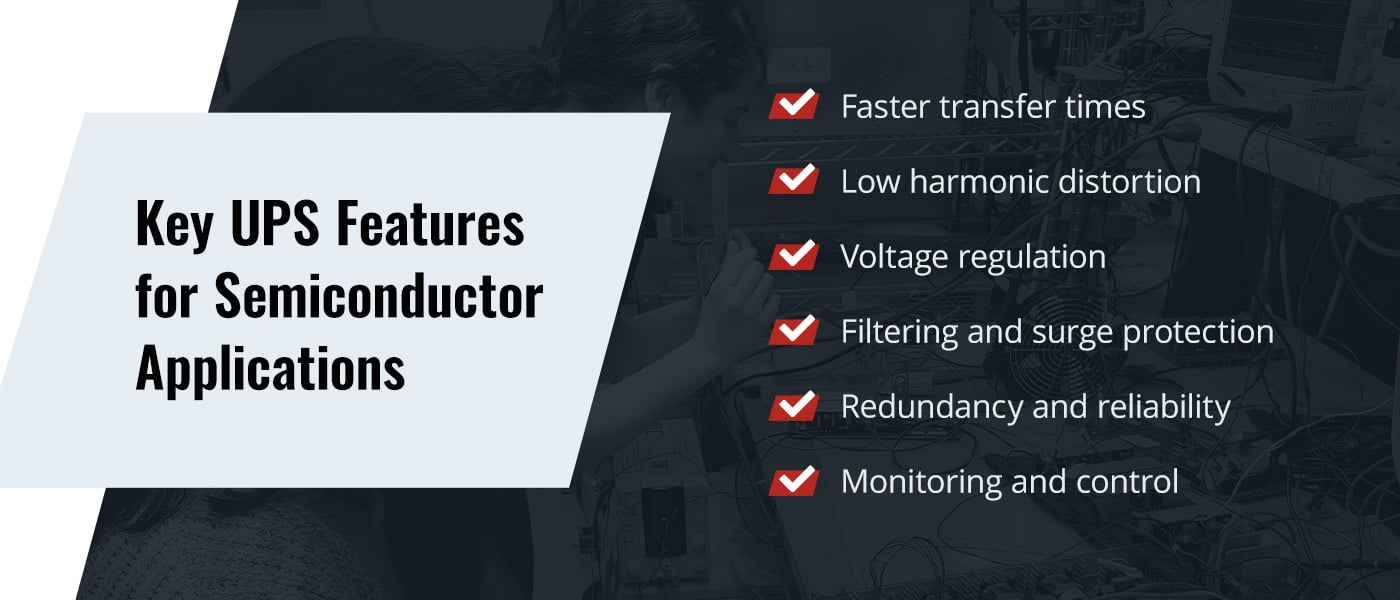
An uninterruptible power supply used in semiconductor applications is designed to support sensitive manufacturing equipment. UPS systems provide near-zero transfer time, controlled voltage with low harmonic distortion, and sag and surge suppression. A UPS includes redundancy, monitoring and scalable capacity so essential tools and clean room utilities continue to operate.
- Near-zero transfer time: Online UPS architectures continuously power equipment from the inverter, eliminating transfer delay during power disturbances and allowing lithography, etch, and deposition tools to continue operating without interruption.
- Low harmonic distortion: Clean inverter output reduces electrical noise and harmonic distortion that could interfere with sensors, alignment systems, and precision motion control used in semiconductor processes.
- Voltage regulation: Maintains tightly controlled output voltage during power instability, protecting sensitive electronics from electrical stress that can degrade accuracy or cause process faults.
- Filtering and surge protection: Integrated filtering and surge suppression prevent voltage spikes, transients, and electrical noise on facility power lines from reaching sensitive semiconductor tools.
- Redundancy and reliability: Modular UPS architectures support N+1 redundancy, balancing load across multiple power modules to maintain continuous operation even if a component fails.
- Monitoring and control: Advanced monitoring provides real-time visibility into power conditions, battery health, and system status, allowing facility teams to proactively manage power infrastructure.
Applications of UPS Systems in Semiconductor Fabs
In semiconductor fabrication facilities, power protection focuses on sensitive systems where interruptions affect yield, recovery time or process control. These systems fall into two groups — production tools that directly process wafers, and facility support systems that maintain clean room conditions and operational stability.
Production Tools
Production tools need continuous electricity to preserve process state and timing during wafer fabrication steps, which can't be paused or resumed without loss of accuracy.
- Lithography equipment: Stable power maintains stage alignment and exposure timing during pattern operations, where interruptions can invalidate wafers mid-process.
- Etching and deposition systems: Continuous electricity sustains plasma behavior and material uniformity, preventing incomplete layers and dimensional variation.
- Process control systems: Reliable power ensures calibration references and real-time coordination, keeping tools synchronized during interruptions.
Support Systems
Support systems maintain the operational conditions that production tools need to operate within the required environmental limits.
- Clean room infrastructure: Power protection maintains airflow, temperature control, and environmental monitoring to preserve clean room conditions and product quality.
- Facility control and monitoring: A stable electrical input ensures supervisory systems are available, providing visibility into tool status and facility conditions.
Benefits of Using a UPS System
A UPS system provides measurable benefits by reducing the operational impact of electrical interruptions in semiconductor manufacturing facilities. By keeping tools and supporting systems operating through interruptions, it maintains production flow, protects equipment and limits the downstream effects of power outages.
The benefits of using a UPS system include:
- Higher effective yield: Fewer process interruptions result in fewer scrapped wafers and more usable output.
- Improved operational continuity: Production schedules remain stable, improving throughput planning and tool utilization.
- Lower equipment costs: Stable power reduces electrical stress on machinery, helping extend service life and reducing maintenance needs.
- Stronger return on equipment: Consistent output and fewer losses lead to improved overall cost efficiency.
Astrodyne TDI Solutions for Semiconductor Manufacturing
In semiconductor manufacturing, power instability leads to direct production and financial losses through diminished output, idle tools, long recovery times, and missed delivery schedules. These losses and interruptions demonstrate why using a UPS system in your semiconductor applications can be beneficial.
UPS systems support stable operations by maintaining consistent electrical delivery across production tools and facility systems. Consistent electrical supply and uptime mean increased productivity, a better yield, and more profit.
Astrodyne TDI designs and manufactures UPS solutions with a focus on fast response and electricity quality. This aligns power protection with real manufacturing requirements and supports reliable operations, even in the most complex of facilities.
Contact us today to discuss how we can help you protect your semiconductor operations against power instability.