

RESOURCES
Overview
Medical carts bring computing, monitoring, and diagnostic equipment closer to the patient. For equipment manufacturers, integrating these devices onto a mobile platform introduces a shared challenge: delivering power that supports the complete system’s electrical, mechanical, and workflow requirements.
This application case study explores how Astrodyne TDI’s medical isolation stations, supported by complementary power and EMI filtering solutions, can help OEMs develop a coordinated power architecture for mobile medical equipment.
Application
Consider a mobile diagnostic cart that combines a computer, display, diagnostic instrument, and accessories. The cart operates from facility AC power during use and moves between clinical locations.
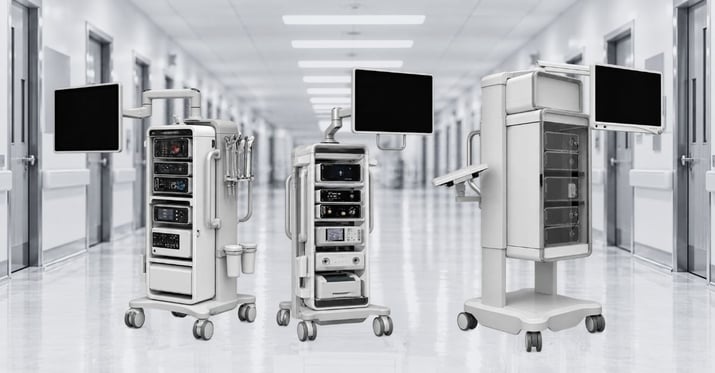
Each connected device has its own electrical requirements. Bringing them together requires decisions about power distribution, isolation, connection access, and whether equipment must remain operational when unplugged.
An isolation station can serve as a central point for supplying isolated AC power to the cart’s connected equipment. If operation away from an outlet is required, a suitable battery or UPS system can be evaluated alongside it.
Application Challenges
Managing isolation and leakage current
Multiple devices and signal connections must be evaluated as part of the assembled system. Individual component approvals alone do not establish that the complete cart meets its applicable electrical safety requirements.
Supporting changing power demands
The power architecture must accommodate simultaneous operation, startup demand, and planned accessories. Selecting capacity requires consideration of both continuous loads and short-duration peaks.
Fitting power hardware into a mobile platform
Transformers, power supplies, and batteries compete with equipment and storage for space. Their placement affects cooling, cable routing, service access, and cart stability.
Matching power continuity to clinical workflow
Some carts can be disconnected during transport; others must maintain operation. Backup requirements depend on the connected equipment, acceptable interruption, and time spent away from an outlet.
Managing electromagnetic interference
Power conversion, computing equipment, and cables share a confined space. EMI filtering must be considered alongside grounding, wiring layout, and leakage-current limits.
Solution
A coordinated design begins with the cart’s load requirements and operating workflow. For applications requiring isolated AC distribution, Astrodyne TDI’s isolation stations combine a medical-grade isolation transformer with power connections in an enclosed assembly.
Configurable outlets and mounting options allow the power arrangement to follow the cart’s equipment layout. Local or remote ON/OFF capabilities can support accessible system control, while a low-leakage design supports the overall electrical safety strategy.
Additional power conversion, EMI filtering, and backup power can be selected according to the application. A cart with an existing battery system may still require isolation or distribution improvements; battery operation and electrical isolation address different design needs.
The resulting configuration should be evaluated with its intended devices, cables, accessories, and operating modes. Isolation-station selection supports this process but does not replace complete-system verification.
Product Offering Details
FLEX Series Medical Isolation Stations
The FLEX Series provides a configurable platform for integrating isolated AC power into medical carts and other equipment.
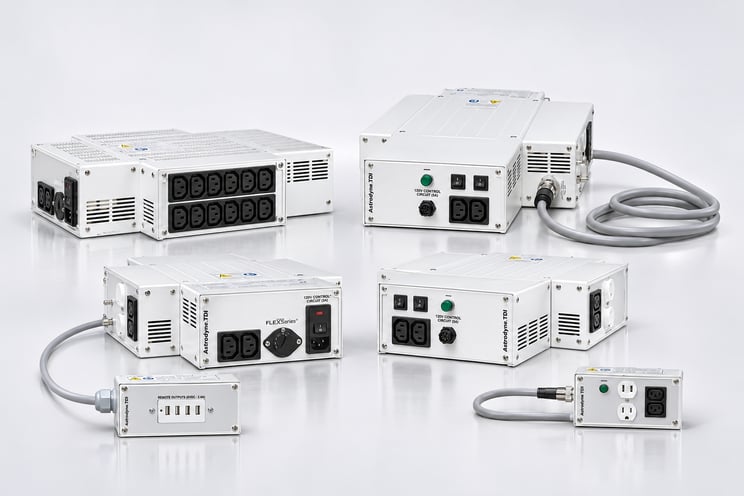
| Feature | Application benefit |
|---|---|
| Enclosed toroidal isolation transformer architecture | Combines isolation hardware in an assembly suited to equipment integration |
| Configurable 100, 120, 220, 230, and 240 VAC options | Supports regional power requirements through the selected configuration |
| Modular NEMA, IEC, and Schuko connection options | Aligns power connections with equipment and destination-market needs |
| Local and remote ON/OFF capabilities | Supports convenient placement of system controls |
| Low-leakage design and equipotential grounding stud | Supports the system’s isolation and grounding strategy |
| Custom mounting and enclosure options | Helps accommodate cart layout, connection access, and service needs |
Voltage arrangements, ratings, connection options, and approvals should be confirmed for the selected configuration.
Complementary Power Solutions
Astrodyne TDI’s broader portfolio supports additional requirements:
- PowerMed™ and other isolation station families: Options for different power levels and packaging needs.
- Medical-grade AC-DC power supplies: Regulated DC power for computing, controls, and other onboard electronics.
- Medical EMI filters: Conducted-noise management selected around the application’s electrical and leakage-current requirements.
- UPS solutions: Backup power evaluated against load, runtime, transfer behavior, and available installation space.
Conclusion
Medical cart power design requires coordination across electrical safety, power capacity, mobility, and mechanical integration. An isolation station provides a practical foundation for applications that need isolated AC distribution to multiple devices.
By considering isolation, conversion, filtering, and backup power together, OEMs can identify integration needs early and develop a power architecture around the complete cart.
Developing a mobile medical platform? Explore Astrodyne TDI’s isolation stations and connect with our team to discuss your application.