

RESOURCES
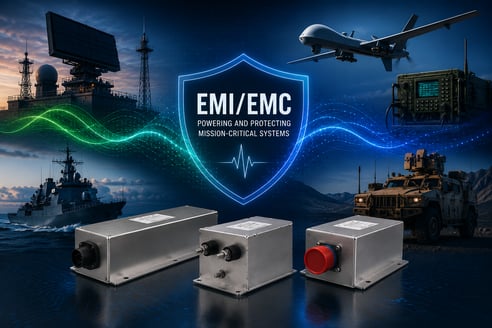 The modern battlefield depends on sophisticated electronics. From radar and sonar platforms to unmanned aerial vehicles, electronic warfare systems, secure communications, and high-energy laser systems, military equipment increasingly relies on advanced power conversion and electromagnetic compatibility (EMC) technologies to ensure mission success.
As defense systems become more connected, powerful, and electronically complex, military OEMs face growing challenges related to power quality, EMI compliance, ruggedization, and cybersecurity. The ability to power and protect these systems has become just as critical as the systems themselves.
The Growing Demand for Reliable Military Electronics
Modern defense systems depend on advanced electronics to support mission-critical operations across land, sea, air, and space environments. As military platforms become more connected, autonomous, and power-intensive, the need for reliable power conversion and EMI/EMC performance continues to grow.
Key applications include:
- Radar Systems
- Sonar Systems
- Electronic Warfare Platforms
- UAVs and Drones
- Ground Combat Vehicles
- Secure Communication Equipment
- High-Energy Lasers
- Navigation Systems
- Military Servers and Displays
- TEMPEST-Protected Systems
Whether designing new platforms or upgrading existing systems, defense manufacturers face increasing challenges related to power quality, electromagnetic interference, environmental ruggedization, and system reliability. Success depends on selecting proven technologies that can perform consistently in demanding operating conditions while helping meet stringent military and regulatory requirements.
Understanding Military EMI and EMC Requirements
Military systems operate in some of the harshest electromagnetic environments imaginable. Failure to control conducted and radiated emissions can impact mission-critical communications, navigation, surveillance, and weapon systems.
MIL-STD-461 Compliance
MIL-STD-461 establishes extensive emissions and susceptibility requirements for military equipment.
The standard includes testing such as:
- CE102 conducted emissions testing down to 10kHz
- CE101 harmonic measurements down to 30Hz
- Conducted and radiated susceptibility testing
- Requirements for AC and DC powered systems
- Compliance across land, naval, and airborne platforms
Every subsystem connected to military power infrastructure must demonstrate compliance to ensure overall platform performance and survivability.
TEMPEST: Protecting Sensitive Information
In military and government applications, protecting sensitive information is just as important as ensuring electromagnetic compatibility. While standards such as MIL-STD-461 focus on controlling electromagnetic interference and emissions, TEMPEST requirements are specifically designed to prevent compromising electromagnetic emanations that could potentially expose classified or sensitive data.
TEMPEST protection is commonly required in secure communication systems, command and control centers, intelligence platforms, servers and networking equipment, classified computing environments, and shielded facilities. These systems must be designed to minimize the risk of unintended signal emissions that could be intercepted or exploited by unauthorized parties.
Achieving TEMPEST compliance typically requires a comprehensive approach to electromagnetic security. This often includes broadband attenuation across sensitive frequency ranges, high-performance EMI filtering, shielded interfaces, Red/Black separation architectures, and specialized connector and enclosure designs. Together, these measures help ensure that critical information remains protected while maintaining the operational performance and reliability required in mission-critical defense environments.
Why EMI Filters Are Critical in Defense Systems
EMI filters serve as the first line of defense against conducted noise entering or leaving military equipment.
Proper filtering helps military systems comply with:
- CE102
- CS116
- RE requirements at power entry points
- Custom harmonic requirements associated with CE101 compliance
Military applications often require more than standard commercial filtering. Shipboard systems, airborne platforms, and secure communication equipment frequently demand specialized designs with unique leakage current, connector, and attenuation requirements.
Military EMI Filter Solutions
Astrodyne TDI offers a broad portfolio of military and TEMPEST-qualified EMI filtering solutions designed to support demanding defense applications. Available solutions include single-phase, three-phase, DC, and IEC inlet filters, with current ratings ranging from low-power electronics to high-power platform-level systems.
|
Filter Type |
Ratings |
|
Single-Phase Filters |
Up to 100A, 300VAC |
|
IEC Inlet Filters |
Up to 20A |
|
Three-Phase Wye Filters |
Up to 150A, 480VAC |
|
Three-Phase Delta Filters |
Up to 225A, 480VAC |
|
DC Filters |
Up to 60A, 400VDC |
|
Harmonic Filters |
Custom designs up to 20A |
These solutions support:
- Performance down to 10kHz
- High ambient operation up to 70°C
- Navy shipboard leakage requirements
- Custom form factors
- MIL-spec connectors
- Specialized mounting configurations
Custom EMI Filters for Military Programs
Many military applications require capabilities beyond standard commercial off-the-shelf products. Custom EMI filters can be developed to provide enhanced attenuation, harmonic mitigation, specialized voltage and current ratings, and reduced leakage current to meet unique program requirements.
Mechanical and interconnection modifications are also common, including custom enclosures, bulkhead mounting, MIL-spec connectors, threaded studs, and shielded cable assemblies. These design enhancements help OEMs meet compliance requirements while reducing development time and qualification risk.
Common EMI Filter modifications include:
-
Electrical Modifications
-
Enhanced attenuation
-
Harmonic mitigation
-
Reduced leakage current
-
Specialized voltage and current ratings
-
- Mechanical Modifications
-
Custom packaging
-
Bulkhead mounting
-
Modified flange configurations
-
Space-constrained form factors
-
-
Interconnection Modifications
-
MIL-spec connectors
-
Threaded studs
-
Shielded cable assemblies
-
Custom wiring harnesses
-
Military Power Supplies: Built for Harsh Environments
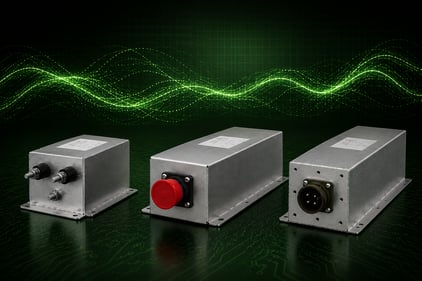 Military power systems must operate reliably in conditions that exceed the limits of conventional commercial electronics. Defense platforms often face extreme temperatures, shock and vibration, high humidity, corrosive environments, and demanding space and weight constraints, all while maintaining long operational lifecycles.
At the same time, next-generation defense programs are driving demand for higher power levels, high-voltage DC architectures, and non-standard voltage requirements. Modern systems increasingly require power solutions capable of supporting advanced sensors, communications equipment, electronic warfare platforms, and autonomous systems.
Military Power Solutions for Land, Air, and Sea
To address these challenges, defense OEMs are adopting a wide range of ruggedized power technologies, including liquid-cooled power systems, DC-DC converters, military UPS systems, programmable power supplies, and modular power architectures. These solutions provide the flexibility and reliability needed across land-based vehicles, naval platforms, airborne systems, and fixed defense infrastructure.
Beyond the product itself, successful military programs depend on engineering partners that understand the complexities of military compliance, qualification, and long-term lifecycle support.
Engineering and Manufacturing Expertise
Military programs require a deep understanding of standards such as MIL-STD-461, MIL-STD-704, MIL-STD-1275, MIL-STD-1399, MIL-STD-810, and TEMPEST requirements. Equally important is the ability to design for reliability through thermal optimization, shock and vibration hardening, environmental testing, and structured design validation processes.
Manufacturing capabilities also play a critical role. U.S.-based engineering resources, ITAR-compatible operations, robust quality systems, and global manufacturing support help ensure programs remain on schedule while meeting performance and compliance requirements.
Powering the Next Generation of Defense Systems
As military platforms become more connected, autonomous, and power-hungry, the importance of reliable power conversion and EMI/EMC protection continues to grow.
Whether supporting radar systems, electronic warfare platforms, secure communications, or next-generation autonomous vehicles, defense OEMs require partners that understand military compliance, rugged design, and long-term program support.
By combining proven EMI filter technologies, rugged power supplies, military UPS systems, and custom engineering expertise, manufacturers can accelerate deployment, reduce qualification risk, and ensure mission success in the world's most demanding environments.