RESOURCES
Every power architecture decision in a data center follows an established playbook except one. Engineers accustomed to 48 V and 54 V systems must now adapt to 800 VDC infrastructure for AI workloads. Much of the existing playbook no longer applies.
This shift is not a matter of raising a voltage number on a spec sheet. Component ratings, protection strategies and EMI profiles have to change. The necessary supplier ecosystem is still emerging, as standards work to keep pace with AI infrastructure deployment.
Understanding 800 VDC infrastructure means you can specify components that are less likely to need to be rerated when protection requirements firm up. You can also start building supplier relationships before the still-forming ecosystem around you hardens.
AI Workloads Are Pushing Racks Past the Limits of Legacy Power Architecture
GPU-accelerated AI workloads often require rack densities exceeding 100 kW, a scale that traditional power architecture can't support. The 54 VDC architecture begins to hit physical limits as racks exceed 200 kW.
800 VDC systems address this problem directly. They accommodate racks with power requirements from 100 kW to over 1 MW, a scale that legacy architecture simply cannot reach.
While 800 VDC architecture solves many of the challenges AI data centers face, the move from low-voltage to high-voltage DC distribution is not straightforward. It requires an entirely different approach to component selection, protection design and thermal management. Traditional distribution cannot simply extend to meet AI data center demands, which is why the shift to 800 VDC represents a redesign rather than an upgrade.
Why 48 V DC Distribution Can't Scale to AI Rack Densities
The physics behind this limitation follows a straightforward chain reaction:
- Higher current → thicker conductors → more copper → more space → more heat → more losses
This reaction makes it much more difficult to upgrade current systems:
- Higher current: Delivering 600 kW at 48 V requires approximately 12,500 amps, a current level that pushes conductor design to its practical limits.
- Thicker conductors: At 48 V, wires must be extremely thick to handle AI level current, which is a physical constraint rather than simply a cost consideration.
- More copper: At a 1 GW data center scale, you will need roughly 200,000 kilograms of copper in rack busbars alone.
- More space: At the megawatt scale, low-voltage DC power shelves would require a dedicated power rack for every compute rack.
- More heat: Each conversion stage introduces losses, increasing the cooling load the facility must absorb.
-
More losses: Legacy architecture suffers from inefficient conversion and high I²R losses at AI-scale power demands.
The Case for 800 VDC Power Distribution
Higher-voltage data center power distribution resolves each constraint in the chain reaction described above, reversing the scaling problem at every stage. Here's how:
- Lower current: 800 VDC requires 750 amps to deliver 600 kW, compared to the 12,500 amps that 48 V requires for the same load.
- Thinner conductors: 800 VDC delivers 85% more power through the same conductor size as 415 VAC.
- Less copper: 800 VDC reduces copper requirements by 45%, easing both material costs and installation complexity.
- More space: Higher power density means more power delivered in a smaller physical footprint, freeing up rack space for compute resources rather than power conversion.
- Less heat: Fewer conversion stages mean fewer points where energy escapes as heat, easing the burden on facility cooling systems.
- Fewer losses: Engineers can expect up to a 5% end-to-end efficiency improvement over legacy architecture.
Still, this upgrade is not a drop-in replacement for existing systems. It requires redesigned protection strategies, new component ratings and updated grounding approaches to meet the demands of high-voltage DC power distribution.
Solid-State Transformers
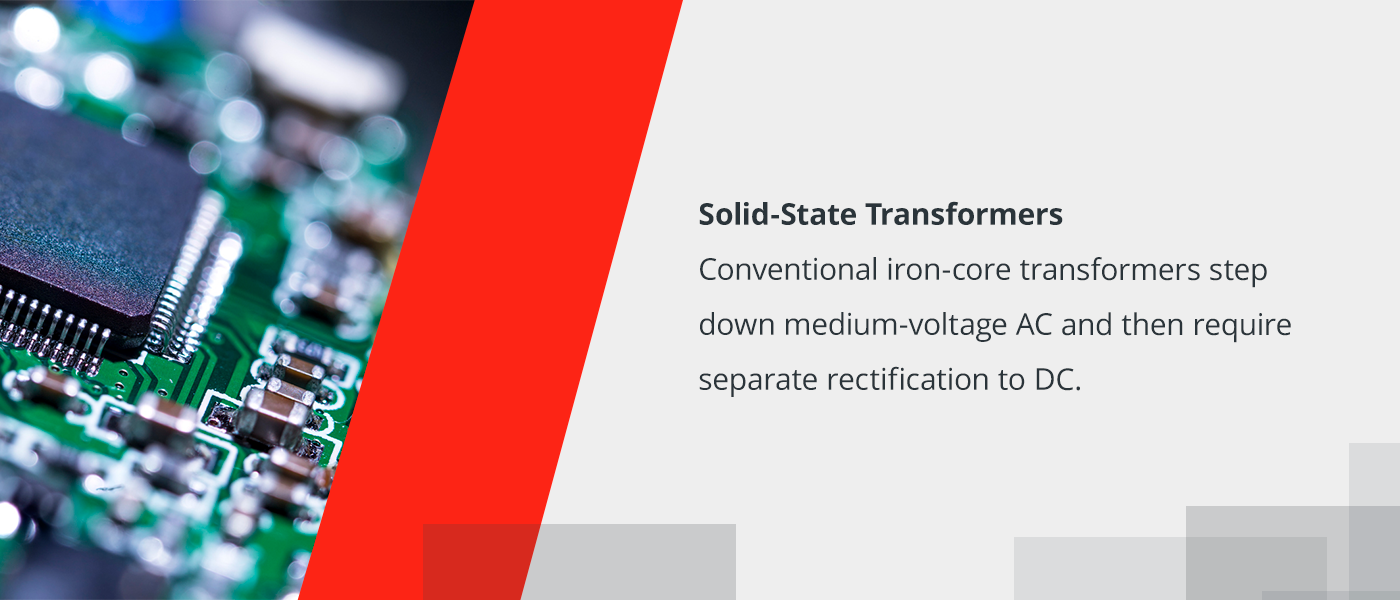
Conventional iron-core transformers step down medium-voltage AC and then require separate rectification to DC. This two-step process carries two sets of losses.
Conversely, solid-state transformers use high-frequency semiconductor switching to convert voltage directly. They output DC power and collapse the conversion chain into a single stage. This approach brings real advantages in size, weight and modularity over conventional transformer designs, making it a natural fit for power conversion in AI data centers.
However, the supporting ecosystem is still forming. The Open Compute Project's SST design specification is currently at version 0.3 and still in development. Engineers evaluating this technology should treat it as an emerging standard, not an established one.
GaN and SiC
Gallium nitride (GaN) and silicon carbide (SiC) semiconductors enable efficient DC/DC conversion in high-density AI racks once 800 VDC power reaches the facility level. Both materials offer a wider bandgap and higher breakdown voltage than traditional silicon.
The wider bandgap allows GaN and SiC to switch faster and generate less heat than silicon components. Even single-digit efficiency improvements compound significantly across the cascaded conversion stages found in AI data center power systems.
The two materials serve different parts of the voltage range. GaN is suited to applications between 30 V and 600 V, while SiC operates in the 600 V to 10 kV range, so it's often better suited for AI data centers. Industries ranging from semiconductor manufacturing to AI infrastructure are adopting SiC technology in their power-supply designs to meet higher-voltage requirements.
What the 800 VDC Shift Means for Power and EMI Suppliers
GaN and SiC-based SSTs and DC/DC converters produce conducted EMI on DC power lines at much higher frequencies than traditional AC filter designs. This shift changes what engineers need from their power and EMI suppliers.
Engineers specifying 800 VDC power systems need three things:
- DC EMI filters purpose-rated for high-voltage DC lines
- AC/DC and DC/DC power supplies built for this voltage class
- Engineering support to navigate a design space where component ecosystems and standards are still maturing
A capable co-design partner should offer high-voltage, off-the-shelf EMI filters, as well as custom solutions to meet the specifications of a given application. For engineers navigating a hybrid environment, that same partner should also cover liquid-cooled power systems, PDUs, UPS systems and pre-compliance EMC testing, so the power chain doesn't require a different supplier at every stage.
Designing for New Facilities and Hybrid Environments
The transition to an 800 VDC data center power supply solution will not happen overnight. For most facilities, the near-term reality is a hybrid environment where new 800 VDC distribution zones coexist with existing 48 V/54 V and legacy AC infrastructure.
This hybrid reality presents a more complex problem than either a clean-sheet 800 VDC build or an all-legacy refresh. Engineers must navigate two sets of protection strategies, two sets of component ratings, different grounding requirements and potentially different compliance frameworks within the same facility.
The same supplier needs to serve both environments confidently. Look for custom solutions for both new and hybrid data center environments, backed by a broad enough product range to support whichever architecture a given zone requires.
Get Started With Astrodyne TDI
AI infrastructure demands coordinated planning across power conversion, distribution, thermal management and EMI/EMC compliance. Each of these pieces depends on the others, and the suppliers you choose now need to be equipped for a voltage class and EMI environment that is still maturing.
Astrodyne TDI covers that full power chain. Our AC/DC and DC/DC power supplies, EMI filters rated up to 1,500 VDC and custom power solutions support both new 800 VDC builds and hybrid environments, alongside PDUs, UPS systems, liquid-cooled power systems and pre-compliance EMC testing.
Our engineers work one-on-one with design teams as genuine co-design partners, from early specification through compliance. Contact our engineers today to find a solution for your AI data center power supply design.