

RESOURCES
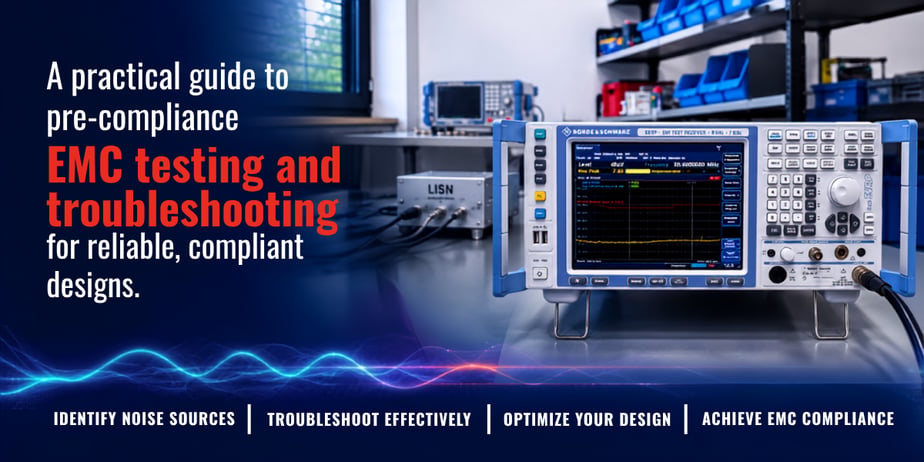
Electromagnetic compatibility (EMC) can be one of the most challenging parts of electronic product development. A system may operate exactly as intended but still encounter problems during formal compliance testing.
The key to reducing that risk is addressing EMC earlier in the design process.
Pre-compliance EMC testing allows engineers to identify potential emissions problems, investigate noise sources, optimize designs, and evaluate EMI filtering solutions before entering formal compliance testing.
Conducted Emissions Troubleshooting: A Practical Approach to EMC
At its core, electromagnetic compatibility means electronic equipment should operate properly in its intended environment without creating unacceptable interference for other equipment.
There are two fundamental sides of EMC:
- Emissions: The equipment should not create excessive electromagnetic interference.
- Immunity: The equipment should continue operating when exposed to electromagnetic disturbances.
For emissions, interference can travel through cables and conductors as conducted emissions or propagate through the air as radiated emissions.
Why Pre-Compliance EMC Testing Matters
EMC should ideally be considered from the earliest stages of product development.
Engineers can begin by understanding the intended operating environment, applicable EMC requirements, system interfaces, and potential noise sources. Once prototypes are available, pre-compliance measurements provide an opportunity to identify and correct problems before formal testing.
This is particularly valuable because formal compliance testing can be time-consuming and expensive, with fewer opportunities to make design changes once testing has begun.
Troubleshooting Conducted Emissions
Conducted emissions are unwanted electrical disturbances that travel through cables connected to a device, including AC power, DC power, and other conductive interfaces.
When troubleshooting conducted emissions, engineers should first understand where the noise is coming from and how it is traveling through the system.
Two important types of conducted noise are:
Differential-mode noise travels in opposite directions along conductors and may require differential-mode filtering.
Common-mode noise travels in the same direction along multiple conductors and may require common-mode chokes, Y capacitors, or improvements to grounding and coupling paths.
Identifying the dominant noise mode helps engineers select the appropriate mitigation strategy instead of simply adding additional filtering.
Small Design Changes Can Have a Big EMC Impact
EMC performance isn't determined by component selection alone. PCB layout, component placement, grounding, cable routing, and filter orientation can significantly affect emissions performance.
During practical testing discussed in our EMC training, relatively simple changes such as increasing spacing between filter components and using a shielded inductor produced significant reductions in conducted emissions.
In another example, changing the orientation of an EMI filter relative to noisy switching circuitry and reducing coupling between the two sections resulted in approximately a 15–20 dB noise reduction.
These examples demonstrate an important principle:
A good EMI filter can only perform effectively when the surrounding system and layout allow it to do its job.
Selecting the Right EMI Filter
Once the source and type of noise are better understood, engineers can evaluate the appropriate filtering solution.
Filter selection should consider more than voltage and current ratings. Important factors can include:
- Common-mode and differential-mode attenuation
- Frequency range of the disturbance
- Leakage-current requirements
- Available installation space
- Number of phases
- Environmental conditions
- Connection requirements
- Applicable safety and regulatory requirements
Depending on the application, engineers may use a standard filter or require a customized solution optimized for the system.
Supporting EMC Troubleshooting at the European Tech Centre
Astrodyne TDI has invested in pre-compliance EMC capabilities at our European Tech Centre (EUTC) to help customers identify and address EMC challenges earlier in product development.
The facility supports conducted emissions measurements, troubleshooting and optimization, and filter insertion-loss measurements. Customers can work alongside our engineers or send equipment to the EUTC for evaluation.
Combined with Astrodyne TDI's EMI/EMC filter portfolio and application engineering expertise, these capabilities allow our team to help customers move from identifying an EMC problem to evaluating and implementing a practical filtering solution.
Download the Astrodyne TDI EUTC Brochure
Address EMC Challenges Earlier
Successful EMC troubleshooting is an iterative process:
Measure → Identify → Modify → Verify
By incorporating pre-compliance testing earlier in product development, engineers can better understand system behavior, evaluate potential solutions, and reduce the risk of discovering major EMC problems during formal compliance testing.
Experiencing a conducted emissions challenge?
Connect with Astrodyne TDI to learn how our application engineering team and European Tech Centre can support your EMC testing, troubleshooting, and EMI filtering requirements.
Custom Solutions from Astrodyne TDI
Astrodyne TDI provides durable and dependable EMI filters for various applications, including industrial, professional-grade appliances, medical, aerospace, semiconductor, and military. Whether you need specialized EMI filters for military or medical applications or cost-effective designs for an appliance, Astrodyne TDI has numerous quality options. Our team of EMI filter engineers can design an EMI filter to meet your specific requirements.
With more than 60 years of experience, Astrodyne TDI is a trusted manufacturer of high-quality EMI filters. Our customers count on us for quality products, unparalleled technical support, and custom product design. We work hard to create EMI filter designs that meet and exceed industry standards and achieve the highest level of quality. Explore our selection of EMI filters if you're looking for an off-the-shelf solution, or submit a quote request to get started on a custom EMI filter designed for your unique needs. For more information about custom and standard EMI filters from Astrodyne TDI and how to make your selection, contact us today.